Here are the notes from my session at the Idaho Horse Expo in April 2026. I may come back and add to it, but I did say I would post it here for folks to reference.
Question number one is why do you want to buy a horse? This dictates most of the details that follow. Answering that question clearly and honestly is the best first step in finding the horse that fits your needs and desires as closely as possible. Do you need a highly trained, specialized horse? Do you need a reliable mount that has a ton of experience? Or a young prospect that you would develop yourself? Question number two: Do you have the ability to ride said highly trained, specialized horse? Will you learn what you need to know to be fair to a horse with a lot of experience? Do you have the skills, experience or mentor to be able to develop a young horse?
Be honest with yourself. The horse doesn’t deserve to go from one level of interaction to an entirely different one, have an inexperienced/unbalanced rider, or tolerate a poor education program just because of what you want. Evaluate yourself and your skills humbly because a horse’s well-being depends on it! And don’t depend on wishful thinking toward yourself or toward the potential horse. For example: If you need a well-schooled horse for the activities you want to do, don’t go too far afield with a poorly trained horse (because it’s cheaper), hoping it will get better. It might, if you’re willing to invest either your own time or a trainer.
Reasons for buying a horse: There are as many reasons to buy a horse as there are people and horses! It could be so many things from a first horse, trail riding/recreation, having access to your own personal horse instead of leases or lesson horses, specific activity or sport, speed events, cattle events, sport horse, breed shows, group activities like drill teams. You may want to grow your skills and challenge yourself to new levels of understanding/connection. Perhaps companionship, or even work like ranching, riding in the back country, farming, or transportation to and from remote areas, and packing. These also play a big role in your selection.
Conformation, or how the horse is put together, is very indicative of appropriate uses and likely future soundness. Conformation is not a beauty contest; it is angles, alignments, and proportions that are most likely to result in a usable horse for the long term. Your education in this area is one of the best insurance policies against buying a horse that will struggle to stay sound. Look online in discussion groups or perhaps there might be a clinic or educational day to learn about conformation. This is knowledge that is useful to every horse person!
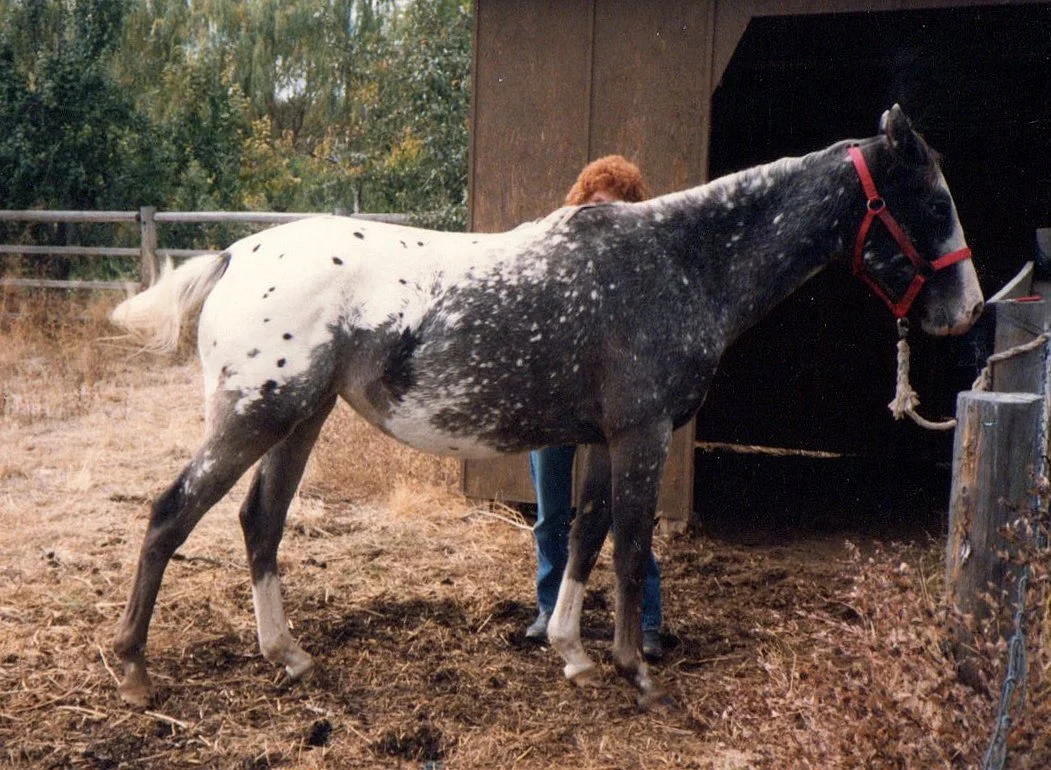
Pretty is as pretty does. This mare was very kind and a pleasure to start. I was about 16 at the time.
Pretty is as pretty does. Not color, feathers, long hair, cute face, or markings. Pretty is a solid basic disposition, a solid education, and a solid exposure history. Make NO assumptions. Don’t even assume that the person selling the horse is telling you the whole story about any given horse. Ask all the questions: How long has the horse been under saddle? Who trained the horse? What activities has he done? Where has he been (the beach, the mountains, horse shows etc)? Has he had any history of lameness? (This is not a deal breaker, by the way). Colic? How is he in a group/stall/pen? (However you are planning to house the horse). How is he to load and stand tied? How is he for regular care? (shots, worming, shoeing, basic first aid). Has he done ________ activity that you would like to do? If I think of more questions, I’ll add them later.
Mare or gelding. Geldings tend to be more settled, as mares do come in and out of heat. Some mares you can’t even tell if they’re in season, but others have very pronounced heat cycles that could interrupt your activities. Mares can be spayed or managed with hormones but that does add extra cost. I’d stay away from stallions. There are far too many, and they will be, to one degree or another, driven by their hormones.
Do not breed unless you are a professional, educated, and dedicated breeder. So many horses find themselves in very bad situations that came about from uneducated or unethical breeders. There are plenty of horses out there.
Rescues. Some folks think that rescuing is the way to find a cheap horse. It’s possible, but many horses from tough situations need professional help to become reliable for the average horse owner, and some never do. It’s a big risk, and having done my share of rescues, I would avoid it. Same with adopting mustangs. Some work out amazingly well, but they have to go through the right hands to get a good education. The breeder of mustangs is Survival, not a quiet disposition or trainability.
Sales. The tough part of livestock sales is that you are only seeing the horse in one situation. They might look pretty shiny or pretty stressed, but that’s all you get to see. The horses may also be drugged. It’s definitely not unheard of. Some ranch sales let you look and ride the horses ahead of time, which is nice, but it’s still seeing the horse in one situation and then possibly bidding a lot of money on it. Online sales are a bit of a new thing. I would be reluctant to participate in those without having someone I trust put eyes on the horse in persons as well as riding anything I might bid on. I think sales are a great place for experienced folks to pick up what they want and need. I think it’s sketchy for new horse folks unless they can take someone with them. Even then, it's riskier than having time to see and ride the horse yourself.
Online advertising sites like Dreamhorse can give you a general idea of the market you are looking into: especially prices and availability. There are some online advertising sites that specialize in a breed or discipline as well. You may very well find the right horse especially if you need something very specific and you are willing to travel to see the horse in person or have someone you know and trust do that for you. Be aware that anyone with any giftedness at all can make a horse look pretty good in videos and pictures. It doesn’t mean that it’s the horse for you.
Gentled to death versus educated. People can be very impressed by horses that tolerate all kinds of nonsense that they would probably never encounter in real life. Tarps, flags, whips, guns, fire, water…on and on. If the horse is okay with all that, it shows that he’s probably not too reactive. But that doesn’t mean he will stay that way. It also doesn’t mean the horse is educated. It just means the horse has been exposed to a lot. You cannot expose a horse to everything they would ever encounter. The best exposure insurance is teaching the horse how to learn to interact with new things, not trying to throw every possibility at them. Education is how the horse responds to the language of the aids: reliably or without any clue at all. I’ve seen both extremes.
Young horses. Sometimes, the middle aged solid educated horses are too expensive, so folks get a young, unstarted horse. This is risky. It can work, but it can end up being a money pit to get the youngster educated, only to find out the horse will not have the disposition or the experience you need to enjoy yourself. Training averages $1200 per month, and a horse, just to be rideable, would take 3 months to start. So add the $3600 you would spend on training to the purchase price. I don’t consider a horse reliable until they have been ridden regularly for a year. I won’t mention colt starters that ruin youngsters, another expensive mistake made by newer horse owners. And please do not get your kid a young horse! That is a recipe for disaster! Yes, there are a few stories of amazing results letting them “grow up together,” but there are far more stories of hospital visits and disappointment.
Size. Bigger is NOT better. Bigger is bigger. I recommend getting the size of horse that suits your desired use and rider size; it’s just easier to get on and off a moderately sized horse. And taller horses tend to have more soundness complications compared to their smaller counterparts.
Breed. Breeds and bloodlines have tendencies, not promises. Not all Arabians are high-strung, and not all drafts are quiet. I’ve ridden a lot of breeds. Many breeds have subtypes within them that are very different from one another. A race-bred quarter horse will have a vastly different everything from a ranch or cutting-bred one and so on. Even a pedigree offers a little insight into a horse's possible abilities and disposition. Think long and hard about this. How much like your great-grandad are you? Not very. Even among full siblings, characteristics can vary wildly. It’s like this, not every child Taylor Swift has would be as talented as she is. Some may be ugly, tone deaf trolls like her aunt Gertrude. So yes, that stallion’s kids might be good at whatever, but it is no guarantee. Look at the horse on the hoof right in front of you. Along with this are athletic and soundness tendencies as well.
Gaited or not. Gaited horses can be a lovely choice for a smooth ride, but can also be limiting in what you can do with them to a degree. Sometimes mixing gaited and non-gaited horses in recreational rides can be a challenge because of the differing speeds of the gaits. Gaited or not, the horse needs to have good basic conformation, disposition, and exposure that will fit your activities. Gaited horses can jump and do some other things, but their claim to fame and breeding selection is based heavily on their smooth gaits on mainly level ground.
The older horse with maintenance. This can be the perfect fit for someone who really needs a horse with experience. A horse to be safe. Just beecause they’re older doesn't necessarily mean they’re the horse for you, but they may be! An older horse who needs soundness support (Adequan, Legend, Previcox, supportive shoeing) can be the perfect partner to get going with, learn a new discipline with, feel safe on, be a lovely starting horse….a lot of things. Don’t overlook these gems!
The double check. Take an equine professional with a good reputation with you to evaluate a horse you believe will be a good prospect for you. They need to know you and your abilities and be able to fairly clearly see if the horse would be an appropriate fit. Oh, then listen to them. That’s usually a good idea!
Have the seller ride the horse first. If they don’t want to ride it, you probably don’t want to either.
Trial periods. This can get pretty tricky because of the risks involved. The current owner of the horse doesn’t want the horse to get hurt or come “untrained.” The buyer wants to work with the horse in various situations. Both sides have a vested interest in the sale working out. One way to mitigate the risk is to put an insurance policy on the purchase price of the horse. You might spend a few hundred bucks, but that may be small change compared to a purchase that doesn’t work out.
See the horse multiple times in multiple situations, especially situations you would like to have the horse accustomed to. If the horse hasn’t seen that kind of situation, simply observe how they are processing it. Are they completely losing their mind or are they a bit upset but might settle down? Ride the horse with the owner/trainer present and learn what the horse knows. It’s not important how you ride at this point, you need to experience and learn what the horse knows. If the horse is a good fit, the two of you can modify how you communicate as you go.
You are going to have a different horse when you get them home. Horses are living, thinking, feeling beings. How they behaved in one situation does not mean they will behave in new situations the same way. It’s like expecting your kids to act the same way in school and at Disneyland. Heck, even compare how they act in school with their regular teacher and a substitute! Another comparison would be to take a child from one home to another. That is a big deal and they will need time, clarity, understanding and some structure to fall into the new routine and new relationships.
Drugs and drug tests: this is a possibility that folks seldom talk about. People drug horses. It happens. Tranquilizers work for a fairly short period of time but can profoundly affect how the horse behaves. There are real crooks out there selling horses. Be aware and try to see if anyone knows the person selling the horse and if they have a good reputation. If you are concerned, you can ask a seller if you can bring a vet to draw blood for a drug test when you come and see the horse the second or third time. Especially if it’s a horse you think might really work out.
Pre purchase exam. A prepurchase exam is not a pass/fail situation. It is information gathering. Does this horse, according to the evaluation of the vet of choice, SEEM to be a good fit physically for the planned activity? That’s it. So a horse that would be perfectly suited for moderate trail riding may not be suitable for endurance riding, dressage, reining, or jumping. Heck, a horse suitable for jumping probably won’t be suitable for cutting. The point is to be able to make an informed decision about bringing the horse into your life. If it’s an older horse with a bit of arthritis, ask what the support protocol would be. How much money would it entail? And is your safety worth it.
One of the trainers I worked with for some years told me, “With horses, you’re going to pay one way or another. You’ll pay the same to fix a young one or a cheap one, just like you’ll pay to get a good one. But you’re going to pay.” By and large, I believe he’s right. Once in a while, you come across an overlooked gem, but it’s not the norm.
Be thoughtful, leave yourself plenty of time to look, be honest with yourself, your abilities, and your own life circumstances, ask questions, get help from trustworthy professionals, and, if it doesn’t work out, be responsible to rehome the horse equitably.
It’s a gamble because no horse is perfect, but it’s okay. We aren’t either.